Introduction: Is Learning Cybersecurity Enough to Build a Career?
Cybersecurity has become an essential part of the digital world. From online banking and e-commerce to healthcare, education and government services, organisations depend on digital systems to manage information and carry out daily operations. Protecting these systems from cyber threats is now a major priority.
As digital technologies continue to evolve, the need for people with cybersecurity knowledge and practical skills continues to grow. This has opened up different career paths for individuals interested in ethical hacking, security analysis, vulnerability assessment, threat detection and digital forensics.
But starting a career in cybersecurity involves more than learning technical definitions or completing a certification.
Imagine knowing what a vulnerability is but not knowing how to identify one in a controlled environment. Or understanding the purpose of a security tool but struggling to interpret its results. These are the kinds of gaps that practical learning can help address.
The real goal of cybersecurity training should be to help learners understand concepts, apply their knowledge and develop the confidence to solve technical problems.
That is why choosing a structured training program matters. Learners need a combination of foundational knowledge, hands-on practice, guidance from experienced professionals and preparation for the workplace.
Cyber Octet’s Advanced Diploma in Cyber Security with AI is designed to bring these elements together while introducing learners to the growing relationship between cybersecurity and artificial intelligence.
What Is the Advanced Diploma in Cyber Security with AI?
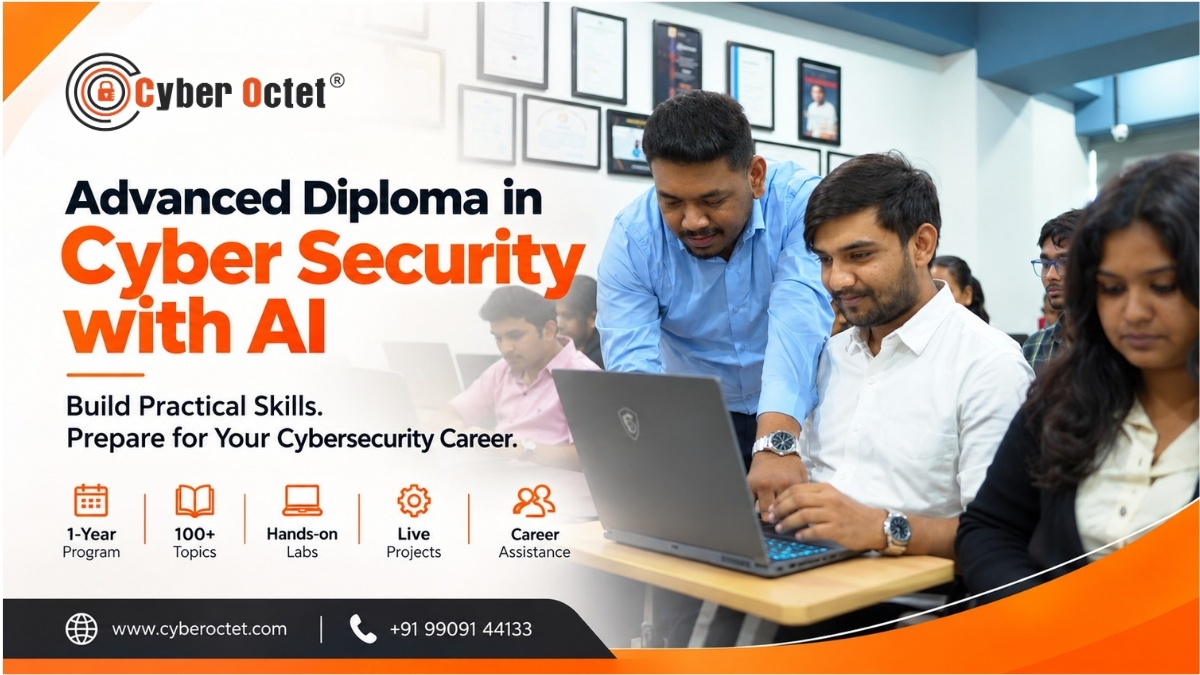
The Advanced Diploma in Cyber Security with AI is a one-year training program offered by Cyber Octet in Ahmedabad. The program covers more than 100 topics and is designed for students and professionals from both IT and non-IT backgrounds.
It combines core cybersecurity concepts with AI-focused learning to help students understand different aspects of digital security.
The program explores topics such as vulnerability assessment, system penetration testing, malware analysis and threat detection. It also introduces AI-driven Open-Source Intelligence (OSINT), automated threat management and emerging AI-related vulnerabilities.
The focus is not simply on learning the names of tools or understanding concepts in theory. Learners are encouraged to develop their analytical abilities, understand security findings and apply their knowledge through practical activities.
Whether you are beginning your career, expanding your technical skills or considering a move into cybersecurity, the program offers a structured way to explore the field.
Why Practical Cybersecurity Training Matters
Cybersecurity is a hands-on discipline. Professionals regularly investigate suspicious activity, examine vulnerabilities, analyse technical information and work to protect digital systems.
Understanding a concept is the first step. Applying it correctly is where practical experience becomes valuable.
1. Learn How Security Assessments Work
Vulnerability assessment and penetration testing help security professionals identify and evaluate weaknesses in systems and applications.
Students need to understand how assessments are conducted, how findings are validated and why vulnerabilities must be documented clearly. Practical exercises can help them connect these concepts with the process of security testing.
2. Develop Problem-Solving Skills
Cybersecurity problems do not always have straightforward answers. A security alert may have several possible explanations, and a vulnerability may affect systems differently depending on the environment.
Practical learning encourages students to investigate issues systematically, ask relevant questions and use evidence to support their conclusions.
3. Understand Security Tools and Their Results
Cybersecurity tools can help identify weaknesses, analyse activity and support investigations. However, using a tool is only one part of the process.
Learners also need to understand what the output means, whether the findings require further validation and how the results should be communicated.
This ability to interpret information is an important part of developing technical competence.
4. Build Confidence Through Repeated Practice
The first attempt at a technical task may not always produce the expected result. Reviewing mistakes, understanding the cause and trying again are important parts of learning.
Regular practice helps learners become more comfortable with technical concepts and recognise areas where they need further improvement.
The aim is not to master every cybersecurity tool immediately. It is to develop a strong foundation and learn how to approach unfamiliar problems.
What Will You Learn in Cyber Octet’s Cybersecurity Course?
The Advanced Diploma in Cyber Security with AI brings together multiple areas of cybersecurity, giving learners an opportunity to explore different technical subjects.
Vulnerability Assessment and Penetration Testing
Vulnerability assessment focuses on identifying potential weaknesses in systems and applications. Penetration testing involves authorised testing to determine whether weaknesses can be exploited under defined conditions.
Learning these areas helps students understand security testing methods, evaluate findings and recognise the importance of remediation.
These skills can be relevant to security assessment and ethical hacking roles, depending on a learner’s practical ability and experience.
Malware Analysis
Malware analysis involves examining malicious software to understand how it behaves, what it may affect and how it could compromise a system.
This subject introduces learners to the investigative side of cybersecurity. It also helps them understand why suspicious files and activities must be examined carefully rather than judged only by their appearance.
Threat Detection
Threat detection focuses on identifying signs of potentially malicious activity.
Learners explore the importance of analysing information, recognising suspicious patterns and determining when an event requires further investigation. These concepts are relevant to security monitoring and Security Operations Centre (SOC) environments.
AI-Driven Open-Source Intelligence
Open-Source Intelligence, commonly known as OSINT, involves gathering and analysing information from publicly available sources for a defined purpose.
AI-driven OSINT explores how artificial intelligence can assist with information processing and analysis. Learners also need to understand the importance of validating results, protecting privacy and using information responsibly.
AI and Emerging Cybersecurity Challenges
Artificial intelligence is changing how information is processed and how digital systems are used. It also creates new security considerations.
The course combines core cybersecurity learning with AI-related topics, including automated threat management and emerging AI vulnerabilities.
This helps learners begin exploring how AI can be used in cybersecurity and why professionals need to understand the security risks associated with evolving technologies.
The objective is to develop an understanding of both cybersecurity fundamentals and the changing technical landscape.
From Theory to Practice: Hands-On Labs and Live Projects
A useful training experience gives students opportunities to apply what they learn rather than relying entirely on lectures and reading material.
Cyber Octet’s training program includes hands-on labs, real-world simulations, live projects and task- and research-oriented learning.
Each of these activities can help learners approach cybersecurity from a practical perspective.
For example, a guided lab can help students practise a technical process in a controlled environment. A research task can encourage them to investigate a topic, evaluate information and explain their findings. A live project can help bring different concepts together while requiring students to organise and document their work.
Practical activities also create opportunities to learn from mistakes. When something does not work as expected, students can investigate the problem, revisit the relevant concepts and improve their approach.
This process helps develop a habit that is particularly valuable in cybersecurity: understanding why something happens instead of simply following a set of instructions.
All security testing exercises should be conducted within authorised environments and clearly defined scopes. Responsible practice is an essential part of learning ethical hacking and cybersecurity.
Why Learn Cybersecurity With AI?
Cybersecurity and artificial intelligence are increasingly connected. AI-based technologies can assist with analysing information, identifying patterns and automating selected tasks. At the same time, AI systems introduce new questions about data protection, access control and security.
For aspiring cybersecurity professionals, understanding this relationship can provide an additional area of learning.
However, learning AI in cybersecurity does not mean skipping the fundamentals. Networking, operating systems, security concepts and analytical thinking remain important for understanding how digital systems operate and how they can be protected.
A balanced approach begins with the basics and gradually explores how AI-based techniques can support cybersecurity activities.
Cyber Octet’s Advanced Diploma in Cyber Security with AI combines core cybersecurity subjects with AI-focused topics such as AI-driven OSINT, automated threat management and emerging AI vulnerabilities.
This combination provides learners with an opportunity to explore an evolving area of technology while continuing to build their cybersecurity foundation.
Who Can Join This Course?
Cybersecurity attracts people with different educational backgrounds and professional goals. The Advanced Diploma in Cyber Security with AI is intended for students, working professionals and business owners, including learners from IT and non-IT backgrounds.
Students and Freshers
Students interested in technology and digital security can use structured training to begin learning cybersecurity concepts, develop practical skills and explore possible career paths.
Working Professionals
Professionals who want to expand their technical knowledge or consider a career transition can explore cybersecurity subjects and identify areas that align with their existing experience.
Career Switchers From Non-IT Backgrounds
People considering a move into cybersecurity can start by understanding the fundamentals and learning what technical skills are required. Consistent practice and a willingness to learn are important, particularly when developing a new technical foundation.
Your starting point will influence your learning journey. If you are new to technology, you may need additional time to strengthen the basics. If you already have relevant experience, you may be ready to explore advanced subjects sooner.
Before enrolling, discuss your background and career goals with the training team so you can understand the course structure and expectations.
Learn From Experienced Cybersecurity Trainers
The quality of cybersecurity training depends not only on the syllabus but also on how effectively concepts are explained, demonstrated and applied.
At Cyber Octet, students learn under the guidance of experienced cybersecurity trainers, including Falgun Rathod, Chief Trainer and Mentor, who is recognised for his work in cybersecurity and ethical hacking.
The training team includes professionals with different areas of expertise, helping students explore cybersecurity concepts from multiple perspectives.
Learning from experienced practitioners can help students understand why particular techniques are used, how security findings are interpreted and what considerations matter beyond the classroom.
Students also play an important role in their own progress. Asking questions, practising consistently, reviewing feedback and documenting what they learn can make the training experience more valuable.
The goal is to develop a strong foundation, improve problem-solving abilities and prepare learners to continue growing in the cybersecurity field.
Career Preparation Beyond Technical Skills
Technical knowledge is important, but building a cybersecurity career also requires communication, documentation and interview preparation.
Cyber Octet’s training program includes career-focused support intended to help students prepare for professional opportunities.
Resume Building
A resume should communicate what you have learned and what you can demonstrate. Describing relevant projects, practical exercises and technical skills clearly can help employers understand your capabilities.
Instead of listing tools without context, try to explain how you used them, what you investigated and what you learned.
Interview Preparation
Cybersecurity interviews may explore fundamental concepts, technical reasoning and the ability to explain problems clearly.
Practising how to describe your approach, discuss project work and answer technical questions can help you prepare for these conversations.
Soft-Skills Training
Cybersecurity professionals often need to explain technical findings to colleagues, managers and clients.
Clear communication, structured reporting and the ability to work with others are useful skills to develop alongside technical knowledge.
Placement Assistance
Cyber Octet provides placement assistance that includes support related to jobs and internships, resume building, interview preparation and soft-skills training.
This support can help learners prepare for opportunities and understand the recruitment process. However, placement assistance does not guarantee employment. Actual outcomes depend on individual skills, preparation, employer requirements and available opportunities.
Students should discuss the current placement process and terms with the training team before enrolling.
What Career Paths Can You Explore After Cybersecurity Training?
Cybersecurity includes several specialisations. The right direction depends on your interests, technical skills, practical experience and continued professional development.
Here are some career paths to explore.
Cybersecurity Analyst
Cybersecurity analysts help organisations understand and respond to security issues. Their work may include reviewing alerts, investigate vulnerabilities and supporting security improvements.
SOC Analyst
Security Operations Centre analysts work with security monitoring systems and alerts to identify potentially suspicious activity and support investigations.
Network Security Engineer
Network security engineers focus on protecting network infrastructure, reviewing security configurations and helping reduce network-related risks.
IT Security Auditor
IT security auditors examine security controls, processes and supporting evidence to assess whether defined requirements are being met.
Malware Analyst
Malware analysts investigate malicious software to understand its behaviour, potential impact and relevant technical indicators.
Digital Forensics Investigator
Digital forensics investigators examine digital evidence to support investigations and help establish what happened during a security incident.
Information Security Officer
Information security officers help manage information security policies, controls, risks and organisational responsibilities.
These are possible career directions, not guaranteed outcomes of completing a diploma. Some roles require additional experience, specialised knowledge or further qualifications. Senior positions, such as Chief Information Security Officer (CISO), generally involve substantial professional and leadership experience.
The most effective approach is to build foundational skills, gain practical experience and gradually develop expertise in the area that interests you most.
How to Choose the Right Cybersecurity Training Program
Before enrolling in a cybersecurity course, take time to understand what the program offers and whether it matches your goals.
Review the curriculum. Check the subjects covered, the depth of learning and whether the course includes the areas you want to explore.
Ask about practical training. Understand what kinds of labs, simulations and projects are included and how your work will be reviewed.
Understand the learning format. Confirm the class schedule, delivery mode, batch size and support available when you need help.
Learn about the trainers. Explore their professional experience and how they connect technical concepts with practical applications.
Clarify career support. Ask what placement assistance includes, whether internship opportunities are available and what responsibilities students have during the process.
Discuss your starting level. If you are new to cybersecurity, understand how the course supports foundational learning. If you already have experience, ask how the program fits your current skills.
These questions help you compare training programs based on the actual learning experience rather than relying only on course titles or promotional claims.
Why Consider Cyber Octet’s Advanced Diploma in Cyber Security with AI?
Cyber Octet’s Advanced Diploma in Cyber Security with AI offers a structured learning path for people interested in developing cybersecurity knowledge alongside AI-focused skills.
The program includes:
- One-year duration with lectures scheduled three days per week.
- 100+ topics covering multiple areas of cybersecurity.
- Hands-on learning through practical labs and real-world simulations.
- Live projects and task- and research-oriented training.
- Experienced trainers and guidance from cybersecurity professionals.
- AI-focused learning covering subjects such as AI-driven OSINT and automated threat management.
- Career preparation through resume building, interview preparation, soft-skills training and placement assistance.
For learners exploring cybersecurity, the key consideration is whether the program aligns with their interests and offers the right balance of foundational knowledge, practical learning and career preparation.
Review the syllabus, understand the schedule and discuss your goals with the training team before deciding.
Final Thoughts
Building a cybersecurity career is a process that involves learning, practice and continuous improvement.
You need to understand the fundamentals, practise technical tasks, investigate problems and learn how to communicate your findings. As technology evolves, you must also remain curious and be willing to develop new skills.
A certificate can document course completion, but your understanding, practical abilities and willingness to learn are what you continue to build on throughout your career.
Choose a learning path that encourages you to ask questions, practise consistently and understand why a security technique works not just which tool to use.
If you want to explore cybersecurity alongside AI-focused learning, Cyber Octet’s Advanced Diploma in Cyber Security with AI is a program worth considering.
Start Your Cybersecurity Learning Journey with Cyber Octet
Ready to explore cybersecurity training in Ahmedabad?
Discover Cyber Octet’s Advanced Diploma in Cyber Security with AI and learn more about the course structure, practical training and career preparation opportunities.
Website: https://www.cyberoctet.com
Phone: +91 99091 44133
Location: Ahmedabad, Gujarat
Contact the Cyber Octet team to discuss your learning goals, course details and upcoming batches.
Frequently Asked Questions
1. What is an Advanced Diploma in Cyber Security with AI?
It is a cybersecurity training program that combines core cybersecurity subjects with AI-focused learning. Cyber Octet’s program covers topics such as vulnerability assessment, penetration testing, malware analysis, threat detection and AI-driven OSINT.
2. How long is Cyber Octet’s Advanced Diploma in Cyber Security with AI?
The program duration is one year, with lectures scheduled three days per week.
3. Can students from a non-IT background learn cybersecurity?
Yes. The program is designed for learners from IT and non-IT backgrounds. Students should be prepared to develop their technical foundation and practise consistently.
4. Does the course include practical training?
Yes. The program includes hands-on labs, real-world simulations, live projects and task- and research-oriented learning.
5. Does Cyber Octet provide placement assistance?
Yes. Career support includes placement assistance, resume building, interview preparation and soft-skills training. Placement assistance does not guarantee a job; students should confirm the current terms with the training team.
6. What career options are available after cybersecurity training?
Possible career paths include cybersecurity analyst, SOC analyst, network security engineer, IT security auditor, malware analyst and digital forensics investigator. Eligibility depends on the skills and experience required for each role.
7. Can working professionals join the course?
The program is intended for students, working professionals and business owners. Contact Cyber Octet to discuss the schedule and suitability for your current commitments.
8. How can I enquire about the course?
Visit https://www.cyberoctet.com or call +91 99091 44133 to enquire about the syllabus, upcoming batches and enrolment process.