At 2:00 AM, an alert doesn’t care whether your analyst is tired.
It doesn’t care whether the incident happened on a Friday night.
And it certainly doesn’t care whether the organization has the latest security tool.
The only question that matters is:
What happens next?
That question sits at the heart of modern cybersecurity operations.
As organizations become increasingly dependent on cloud platforms, connected devices, digital services and distributed infrastructure, security teams are dealing with more data, more alerts and increasingly complex threats.
The role of the Security Operations Center (SOC) has therefore changed.
A SOC is no longer simply a place where analysts sit in front of dashboards waiting for something suspicious to appear.
It is becoming an intelligent security function where people, processes, technology and intelligence work together to understand threats and make better decisions.
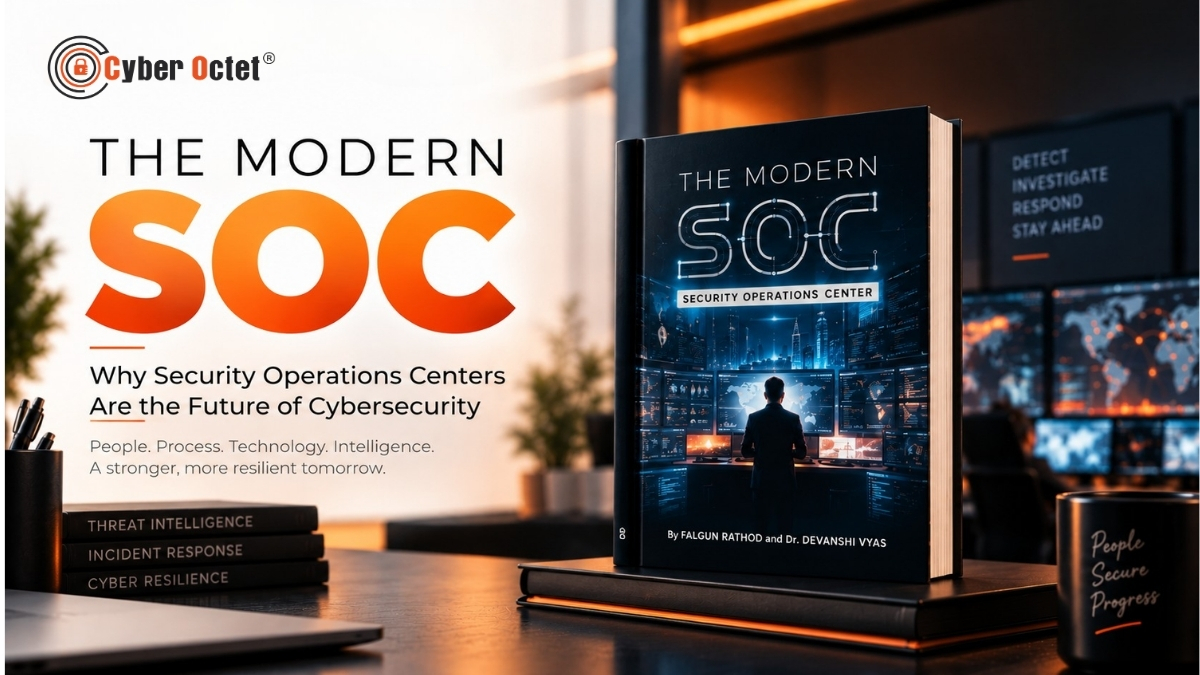
This evolution is the focus of The Modern SOC – Security Operations Center, authored by Falgun Rathod and Dr. Devanshi Vyas.
What Is a Security Operations Center?
A Security Operations Center (SOC) is a centralized security function responsible for continuously monitoring an organization’s digital environment, identifying suspicious activity, investigating potential threats and supporting incident response.
But defining a SOC only by its technology misses the bigger picture.
A mature SOC brings together:
- Security monitoring
- Threat detection
- Incident investigation
- Threat intelligence
- Incident response
- Security analytics
- Automation
- Skilled security professionals
- Defined processes and workflows
The book takes a broader view, describing the SOC as a combination of people, technology and processes and ultimately as a culture of awareness and readiness.
That distinction matters.
Because an organization can buy the latest security platform and still have an immature SOC.
Why Do Organizations Need a Modern SOC?
Cybersecurity has moved beyond the traditional perimeter.
Organizations today may have employees working remotely, workloads running in multiple cloud environments, connected devices, third-party services and business applications generating enormous amounts of security data.
At the same time, attackers are becoming increasingly automated and capable of operating across complex digital environments.
This creates a basic problem:
Security teams have more information than ever but information alone does not create security.
The information has to be interpreted.
An alert needs context.
An incident needs prioritization.
A suspicious event needs investigation.
And someone needs to decide what action should be taken.
This is where a modern SOC becomes important.
NIST’s current incident-response guidance similarly emphasizes integrating incident response into broader cybersecurity risk management and improving the effectiveness of detection, response and recovery activities.
From SOC 1.0 to SOC 3.0
One of the most useful ways to understand the changing role of a SOC is to look at its evolution.
SOC 1.0 The Reactive Era
The traditional SOC was primarily focused on detection and containment.
Security teams depended heavily on SIEM rules, signatures and manual analysis.
An alert appeared.
An analyst investigated it.
The team responded.
This model established the foundations of security operations, including discipline, documentation and continuous monitoring.
But it also created a familiar problem:
Alert volume can grow faster than human attention.
The book describes SOC 1.0 as an environment that relied heavily on people and manual processes and often struggled with visibility and alert volume.
SOC 2.0 The Adaptive Era
SOC 2.0 changes the way security teams work.
Automation, orchestration, analytics and threat intelligence become much more important.
Technologies and approaches such as SOAR and XDR help security teams enrich alerts, automate repetitive actions and connect information from different security environments.
Instead of asking an analyst to manually investigate every low-level alert, automation can help with triage and enrichment.
This doesn’t eliminate the analyst.
It changes the analyst’s role.
The book describes this transition as moving analysts from being constant “firefighters” toward becoming more informed decision-makers and strategists.
SOC 3.0 The Predictive and Autonomous Era
The next step is even more ambitious.
SOC 3.0 moves toward predictive and increasingly autonomous security operations.
Instead of simply asking:
What happened?
the security operation begins asking:
What is likely to happen next?
This model brings together:
- AI and machine learning
- Threat prediction
- Risk modelling
- Data lakes
- Advanced analytics
- Automated response
- Business context
- Cross-environment correlation
The goal is not simply to process more alerts.
The goal is to understand threats more deeply and act more intelligently.
Does AI Replace SOC Analysts?
This is probably one of the biggest questions surrounding the future of security operations.
Not in the way many people imagine.
AI can help process large amounts of data, identify patterns, enrich alerts and automate repetitive tasks.
But cybersecurity decisions often require context.
For example:
Is the activity actually malicious?
What system is involved?
What information could be affected?
What is the business impact?
Should the incident be escalated?
Can the response safely be automated?
These are decisions where human judgment remains extremely important.
The book’s perspective is clear: the future analyst is not necessarily removed from the SOC. Instead, the analyst’s role evolves toward guiding intelligent systems, validating insights and making strategic decisions.
NIST’s guidance on AI-related systems similarly emphasizes the importance of human oversight, monitoring and validation rather than treating AI output as automatically trustworthy.
The Four Foundations of a Modern SOC
A modern SOC needs more than technology.
Think of it through four interconnected areas.
1. People
Analysts, investigators, engineers, threat hunters, incident responders and security leaders.
Technology can generate a signal.
People determine what the signal means.
2. Process
A SOC needs clear workflows for:
- Detection
- Investigation
- Escalation
- Containment
- Response
- Recovery
- Lessons learned
Incident response is not an isolated technical activity. Current NIST guidance treats it as part of broader cybersecurity risk management and emphasizes continuous improvement.
3. Technology
Modern SOC environments may include:
- SIEM
- SOAR
- EDR/XDR
- Network security
- Cloud security
- Threat intelligence platforms
- Security analytics
- Automation
But technology should support the security operation — not become the operation itself.
4. Intelligence
A security alert tells you that something happened.
Intelligence helps you understand why it matters.
Threat intelligence, contextual enrichment and correlation can help security teams move from isolated events toward a broader understanding of an attack.
The Human Side of the SOC
There is an interesting contradiction in cybersecurity.
The more technology we introduce, the easier it is to forget the people operating it.
But behind every alert is a person making a decision.
Someone has to investigate the unusual login.
Someone has to determine whether a suspicious process is legitimate.
Someone has to stay with an incident when the rest of the organization has gone home.
Someone has to make the call when the available information is incomplete.
The book pays particular attention to these people — analysts, engineers and leaders who work behind the scenes to keep digital environments secure.
That human element is one of the reasons a modern SOC should not be measured only by the number of tools it has.
It should also be measured by the quality of the decisions its people can make.
What Does a Modern SOC Actually Do?
A modern SOC can be involved in a wide range of security activities.
Depending on the organization’s maturity and operating model, this can include:
Continuous monitoring
Watching security events across networks, endpoints, applications and cloud environments.
Threat detection
Identifying patterns and activities that may indicate malicious behavior.
Incident investigation
Connecting individual alerts and events to understand what actually happened.
Threat intelligence
Using information about threats, attackers and techniques to improve detection and response.
Incident response
Coordinating actions to contain, investigate and recover from security incidents.
Security automation
Reducing repetitive manual tasks and accelerating common response workflows.
Security analytics
Using data and correlation to identify patterns that may not be obvious from individual events.
The book explores these operational areas alongside SOC structures, advanced security domains and the future evolution of SOCs.
Why SOC Maturity Matters
Not every organization needs the same SOC.
A startup, a large enterprise, a financial institution and a critical infrastructure organization may have very different requirements.
The important question is therefore not:
“Do we have a SOC?”
It is:
“Is our SOC mature enough for the threats we face?”
A mature security operation should be able to evolve as the organization evolves.
That means looking beyond tools and considering:
- People and skills
- Operating models
- Processes
- Detection capabilities
- Incident response
- Threat intelligence
- Automation
- Metrics
- Governance
- Risk
- Business impact
This is also where cybersecurity begins to connect directly with organizational resilience.
CISA, for example, frames cybersecurity and resilience as interconnected concerns for critical infrastructure because disruptions to interconnected systems can have broader operational and economic consequences.
What Does the Future of the SOC Look Like?
The direction is already becoming clear.
The SOC is moving from:
Reactive → Adaptive → Predictive
From:
Manual → Automated
From:
Alert-focused → Context-aware
And from:
Technology-centric → Business-aware
The future SOC may be able to correlate signals across cloud, endpoints, networks, users and other environments in real time.
It may automatically investigate common patterns.
It may use AI to identify anomalies and recommend responses.
It may connect a technical security event with its potential business impact.
But the fundamental objective remains unchanged:
Understand what is happening.
Make the right decision.
Respond before the damage grows.
Why We Wrote The Modern SOC
The Modern SOC – Security Operations Center is the third book authored by Falgun Rathod and represents a new chapter in his work, this time co-authored with Dr. Devanshi Vyas.
Falgun Rathod brings more than 17 years of experience across information security, cybercrime investigation and enterprise cyber defence, with more than 400 cybersecurity projects and over 250 cyber incident investigations.
Dr. Devanshi Vyas brings more than 15 years of experience across cybersecurity, risk management and compliance, with expertise in governance, enterprise risk and cyber resilience.
Their perspectives come together around a simple idea:
A SOC is not just a technology stack.
It is a combination of people, processes, technology, intelligence and judgment.
And as the threat landscape changes, the SOC has to change with it.
Frequently Asked Questions About Modern SOCs
What is a Security Operations Center?
A Security Operations Center, or SOC, is a security function responsible for monitoring an organization’s digital environment, detecting suspicious activity, investigating threats and supporting incident response.
What is a modern SOC?
A modern SOC combines people, processes, technology, threat intelligence, analytics and automation to improve an organization’s ability to detect, investigate and respond to cyber threats.
What is SOC 2.0?
SOC 2.0 represents a more adaptive model of security operations that makes greater use of automation, orchestration, analytics and threat intelligence.
What is SOC 3.0?
SOC 3.0 describes the movement toward predictive and increasingly autonomous security operations using AI, analytics, automation and business context.
Will AI replace SOC analysts?
AI can automate repetitive work and assist with analysis, but human judgment remains important for interpreting context, validating insights and making strategic security decisions.
Why is threat intelligence important for a SOC?
Threat intelligence provides additional context about threats and attacker behavior, helping security teams improve detection, investigation and response.
Who should learn about SOC operations?
Cybersecurity students, SOC analysts, security engineers, incident responders, threat hunters, CISOs, IT leaders and professionals working across cybersecurity, risk and compliance can all benefit from understanding modern SOC operations.
The SOC Is More Than a Security Function
A modern SOC is not simply about watching screens.
It is about creating an environment where an organization can see what is happening, understand what it means and respond with confidence.
The technology will continue to change.
AI will become more capable.
Attacks will continue to evolve.
But the need for skilled people, strong processes and sound judgment will remain.
Because ultimately, cybersecurity is not just about detecting threats.
It is about being ready when they arrive.
Explore The Modern SOC – Security Operations Center
By Falgun Rathod & Dr. Devanshi Vyas
Available worldwide.
👉 Get your copy: https://amzn.in/d/06tLctrw