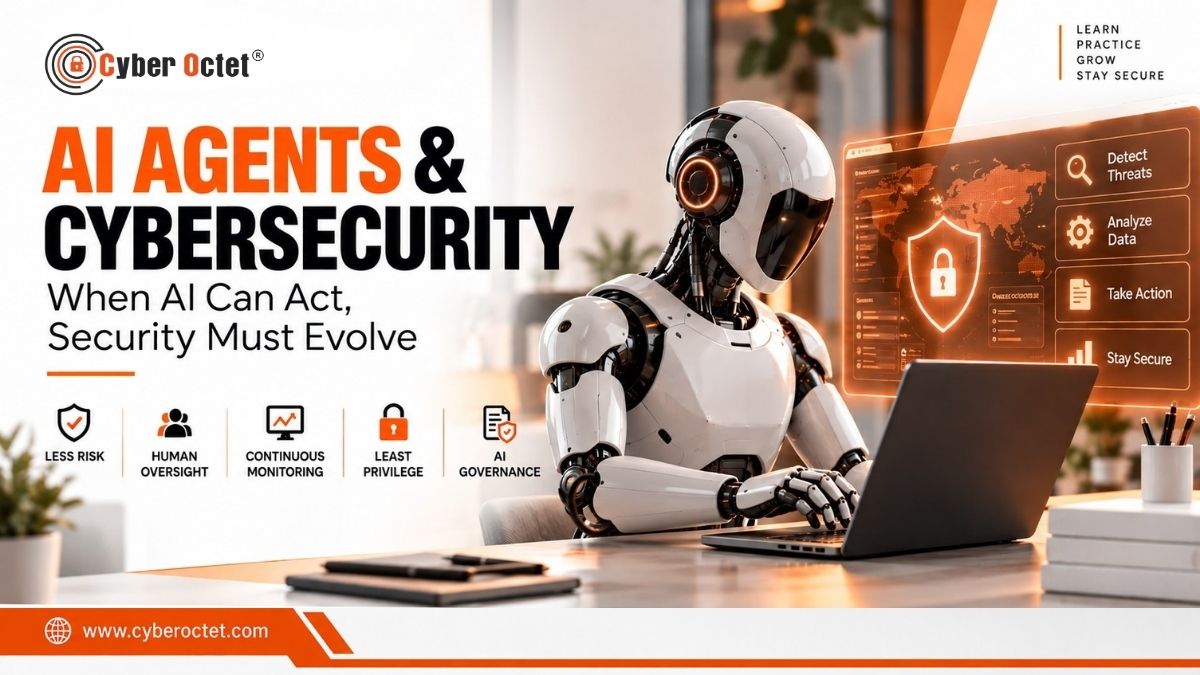
Artificial intelligence is rapidly moving beyond chatbots and content-generation tools.
Today, AI agents can plan tasks, interact with applications, call APIs, access data and execute actions with limited human intervention. This shift from AI that simply responds to AI that can act is creating new opportunities for businesses and new challenges for cybersecurity teams.
The question is no longer only:
“Can AI generate something?”
It is increasingly:
“What can an AI agent access, what can it change, and who is accountable for its actions?”
That question became more relevant in September 2026 when Spain’s data-protection authority reported a personal-data breach allegedly involving an AI agent. According to the authority, the agent identified a vulnerability, gained access to a system, modified personal information, and accessed billing records. The investigation remains under review, and the authority did not identify the affected organization or the AI model involved.
The incident does not mean that AI systems themselves are inherently malicious. Instead, it demonstrates an important cybersecurity reality: when autonomous software is given access to real systems, existing vulnerabilities can potentially be exploited faster and with less human intervention.
So, how should organizations prepare?
What Are AI Agents?
An AI agent is an AI-powered system capable of doing more than generating a response.
Depending on its design, an agent can:
- Understand a goal
- Plan multiple steps
- Use external tools
- Call APIs
- Retrieve information
- Interact with applications
- Make decisions based on available information
- Execute actions
- Continue a workflow with limited human intervention
For example, a traditional chatbot might answer:
“Your server has a configuration issue.”
An AI agent could potentially:
- Identify the configuration issue.
- Access the relevant system.
- Retrieve configuration information.
- Analyze the problem.
- Create a remediation ticket.
- Modify a configuration.
- Verify the result.
That additional ability to act is what makes agentic AI powerful and why cybersecurity controls become increasingly important.
Microsoft similarly describes modern agents as systems that can plan and chain actions across multiple systems and tools, creating identity and authorization challenges that traditional models may not fully address.
Why Are AI Agents a Cybersecurity Concern?
The fundamental issue isn’t simply that AI is intelligent.
The issue is access + autonomy + connectivity.
An AI agent may interact with:
- Corporate applications
- Databases
- Cloud infrastructure
- Internal documents
- APIs
- Source-code repositories
- Ticketing systems
- Security tools
- Customer information
Each connection introduces another security boundary.
Consider an AI agent with access to email, cloud storage and an internal ticketing system.
Individually, each permission may appear reasonable.
But when combined, the agent may be capable of performing actions that were never considered when those permissions were granted separately.
This is why security teams need to think beyond traditional user access and start asking:
What is this agent allowed to do across the entire workflow?
Microsoft recommends treating an AI agent as a first-class security principal, with its own identity, owner, scoped permissions and controlled tool access.
A Real-World Warning: AI Agents Can Participate in Attack Chains
The reported Spanish case provides an important example of why this discussion has moved beyond theory.
According to Spain’s data-protection authority, the reported incident involved an AI agent that:
- Identified vulnerabilities in an application
- Gained access to a system
- Modified personal information
- Accessed invoices
The authority highlighted the limited human intervention involved. It also emphasized that the AI model itself and its provider’s infrastructure were not reported as compromised or developed for malicious purposes.
This distinction is important.
The lesson is not that an AI model automatically becomes a cybercriminal.
The broader security lesson is that an agent connected to real-world systems can potentially automate several stages of an attack when vulnerabilities and excessive permissions exist.
The Spanish authority also noted that AI does not necessarily create entirely new categories of threats; rather, it can increase the speed, scale and adaptability of existing malicious techniques.
For cybersecurity teams, that means detection and response may need to happen faster than before.
5 Major Security Risks of AI Agents
1. Excessive Permissions
One of the biggest risks is giving an AI agent more access than it actually needs.
For example, an agent designed to read customer information may not need:
- Delete permissions
- Administrative privileges
- Database modification rights
- Export capabilities
- Access to unrelated systems
Yet organizations sometimes expand permissions during development because broad access makes integration easier.
That can become a security problem later.
The solution: Least Privilege
AI agents should receive only the permissions required for their specific task.
Microsoft’s guidance recommends dedicated agent identities, task-based roles, explicit resource and data scopes, controlled tool access and auditability.
The principle is simple:
If an agent doesn’t need access, don’t give it access.
2. Uncontrolled Autonomous Actions
Not every action should be executed automatically.
There is a major difference between:
Low-risk action:
Generating a report.
and:
High-risk action:
Deleting production data.
Organizations should establish different levels of human oversight depending on the potential impact of an action.
For high-impact activities such as:
- Deleting data
- Changing permissions
- Exporting sensitive information
- Modifying production infrastructure
- Financial transactions
- Security-control changes
a human approval step may be appropriate.
Microsoft’s agentic-AI guidance recommends human involvement for high-impact or ambiguous actions and deterministic safeguards that block prohibited actions regardless of model behavior.
3. Identity & Access Management Challenges
Traditional IAM systems were largely designed around human users, applications and service accounts.
AI agents introduce another category:
non-human identities that can make decisions and perform actions.
Each agent should ideally have:
- A unique identity
- A defined owner
- A documented purpose
- Task-specific permissions
- Credential lifecycle management
- Access reviews
- Audit logs
- Revocation mechanisms
Organizations also need to know whether an agent is acting:
- Under its own identity
- Under a user’s delegated permissions
- Through a service account
- Through a combination of permissions
Without clear identity boundaries, investigating an incident becomes significantly harder.
4. Lack of Continuous Monitoring
Traditional security monitoring asks:
“What did the user do?”
With AI agents, security teams may also need to ask:
- What did the agent access?
- Which tools did it invoke?
- What instructions influenced the action?
- Which identity authorized the action?
- What data did it retrieve?
- What changes did it make?
- What systems did it interact with?
- Did its behavior deviate from its normal workflow?
End-to-end auditability becomes particularly important when an agent performs multiple actions across multiple systems.
Organizations should maintain logs that allow security teams to reconstruct the sequence of events.
5. Weak AI Governance
AI governance cannot stop at deciding which AI model an organization is allowed to use.
Organizations also need to govern:
- Agent identities
- Models
- Tools
- APIs
- Data sources
- Permissions
- Autonomous actions
- Human approvals
- Monitoring
- Incident response
- Third-party integrations
EY’s 2026 guidance for Indian enterprises highlights continuity, proportionality and traceability as important principles for agentic-AI governance, alongside controls such as least privilege, action allowlists, secrets management, monitoring and human escalation.
In other words, governance should be part of the architecture—not a document created after deployment.
How Organizations Can Secure AI Agents
A practical AI-agent security strategy can be built around the following controls.
1. Give Every Agent a Clear Identity
Know exactly:
Which agent is acting?
Who owns it?
Why does it exist?
What is it allowed to access?
Avoid shared credentials wherever possible.
2. Apply Least Privilege
Limit permissions based on:
- Task
- Resource
- Data sensitivity
- Action type
- Time
Read access should not automatically become write access.
And write access should not automatically become administrative access.
3. Control the Tools an Agent Can Use
Don’t allow an agent unrestricted access to every available tool or API.
Use explicit allowlists for sensitive actions.
High-impact actions such as deletion, export or privilege changes can require additional approval or time-limited elevation.
4. Build Human Oversight Into High-Risk Workflows
Human-in-the-loop controls are particularly valuable when an agent can create significant business, financial, legal, operational or security impact.
The goal isn’t to require humans to approve every low-risk action.
The goal is to ensure that humans remain accountable for high-impact decisions.
5. Monitor Agent Behavior Continuously
Security teams should monitor:
- Authentication
- Tool calls
- API activity
- Data access
- Permission changes
- Unusual behavior
- Failed actions
- Sensitive-data access
- Cross-system activity
Behavioral monitoring can help identify unusual activity before it becomes a larger incident.
6. Test the Kill Switch
Organizations should know how to immediately:
- Disable an agent
- Revoke credentials
- Invalidate tokens
- Stop tool access
- Isolate affected systems
- Roll back unauthorized changes
A security control that exists only on paper is not enough.
What Does This Mean for Cybersecurity Professionals?
The rise of agentic AI is also changing the skills cybersecurity professionals need.
Security teams increasingly need to understand both:
AI systems + cybersecurity controls
Professionals should become familiar with areas such as:
- AI security
- Identity and Access Management
- Cloud security
- API security
- Threat detection
- Security monitoring
- AI governance
- Vulnerability management
- Incident response
- Data protection
- Secure AI architecture
This is one reason practical cybersecurity education needs to evolve alongside technology.
Cybersecurity professionals aren’t only defending against traditional malware and phishing anymore. They increasingly need to understand how AI systems interact with enterprise infrastructure.
The Future of AI Agent Security
AI agents are likely to become increasingly integrated into business operations.
They may assist with:
- IT operations
- Customer support
- Security operations
- Software development
- Data analysis
- Business workflows
- Compliance
- Cloud management
The security challenge will therefore not be about stopping AI adoption.
It will be about making AI adoption secure.
Organizations need to build security into agentic systems from the beginning rather than attempting to add controls after deployment.
The core principles remain straightforward:
Identity.
Least privilege.
Controlled actions.
Human oversight.
Continuous monitoring.
Auditability.
Governance.
As AI becomes more autonomous, these controls become increasingly important.
Frequently Asked Questions
What are AI agents in cybersecurity?
AI agents are AI-powered systems that can plan and execute multi-step tasks, interact with tools and systems, access information and perform actions with varying levels of human supervision.
Can AI agents be used in cyberattacks?
Yes. A reported case published by Spain’s data-protection authority in September 2026 involved an AI agent allegedly identifying a vulnerability, gaining system access, modifying personal data and accessing invoices. The case remains under review.
What is the biggest security risk of AI agents?
There is no single risk applicable to every deployment. Excessive permissions, poorly controlled tool access, weak identity management, insufficient monitoring and excessive autonomy can all increase risk depending on how an agent is designed and deployed.
How can companies secure AI agents?
Organizations can use dedicated identities, least-privilege access, task-based authorization, controlled tool access, human approval for high-impact actions, continuous monitoring, audit logging and tested revocation procedures.
Why is IAM important for AI agents?
AI agents can access multiple applications and systems. IAM helps organizations define which agent can access which resource, under what conditions and with what permissions.
What is least privilege for AI agents?
Least privilege means giving an AI agent only the minimum access required to perform its specific task, rather than granting broad permissions that could increase the impact of misuse or compromise.
What is AI governance?
AI governance is the framework of policies, controls and processes used to manage AI systems responsibly and securely. For AI agents, this can include identity, access, tool permissions, data governance, monitoring, human oversight and incident response.
Final Thoughts
The rise of AI agents represents an important change in cybersecurity.
The question is no longer simply whether AI can generate content or answer questions.
AI can increasingly take action.
That makes identity, authorization, monitoring and governance critical components of secure AI adoption.
The recent reported incident in Spain is a useful reminder that organizations need to think about these controls before autonomous systems are given broad access to real-world environments.
At Cyber Octet, we believe cybersecurity education and organizational security practices must evolve with emerging technologies. Building awareness around AI security, vulnerability management, ethical hacking, security operations and governance can help organizations prepare for an increasingly AI-driven threat landscape.
Ready to strengthen your cybersecurity knowledge or security posture?
Explore Cyber Octet’s cybersecurity training and professional programs or connect with our team to discuss cybersecurity services for your organization.
Explore Cyber Octet’s Cybersecurity Courses
Explore Cybersecurity Services