Every year, thousands of students complete cybersecurity certifications with the dream of landing a high-paying job. They spend months learning networking, ethical hacking, penetration testing, digital forensics, cloud security, and security operations. Yet, when they begin applying for jobs, many receive little to no response from recruiters.
If you’ve experienced this, you’re not alone.
The truth is that getting hired in cybersecurity isn’t just about earning certifications or completing a course. Employers look beyond technical knowledge. They want candidates who can demonstrate practical skills, communicate effectively, solve real-world security problems, and present themselves professionally.
Your hiring journey begins long before the interview. It starts with an ATS-friendly resume, a strong LinkedIn profile, hands-on projects, and the confidence to explain your skills during technical interviews.
Whether you’re a student, fresher, or working professional, choosing the right Cyber Security Course is the first step toward building a successful career.
In this comprehensive guide, we’ll walk you through every stage of the hiring process—from creating a resume that gets shortlisted to confidently cracking technical interviews and securing your first cybersecurity role.
Why Many Cyber Security Candidates Don’t Get Interview Calls
One of the biggest misconceptions among freshers is believing that certifications alone are enough to secure a job.
While certifications certainly strengthen your profile, recruiters usually evaluate candidates based on a combination of factors:
| What Candidates Think | What Recruiters Actually Look For |
| Certifications | Practical Skills |
| Course Completion | Hands-on Projects |
| Long Resume | Relevant Resume |
| Multiple Tools Listed | Ability to Use Those Tools |
| High Scores | Problem Solving Ability |
| Theoretical Knowledge | Practical Experience |
Imagine two candidates applying for the same SOC Analyst position.
Candidate A has completed several certifications but has no practical projects.
Candidate B has completed fewer certifications but has built a home lab, participated in Capture the Flag (CTF) challenges, documented projects on GitHub, and can confidently explain real-world scenarios.
In most cases, Candidate B is more likely to be shortlisted because employers value practical experience over theoretical knowledge.
The key takeaway? Your resume should not only list what you’ve learned—it should demonstrate what you can actually do.
Step 1: Build a Resume That Gets Shortlisted
Your resume is your first opportunity to impress a recruiter. In many organizations, recruiters spend less than a minute reviewing each resume before deciding whether to move a candidate to the next stage.
This means your resume should be clear, concise, and focused on relevance rather than length.
Keep Your Resume ATS-Friendly
Most companies use an Applicant Tracking System (ATS) to filter resumes before a recruiter even sees them. If your resume isn’t ATS-compatible, it may never reach a hiring manager.
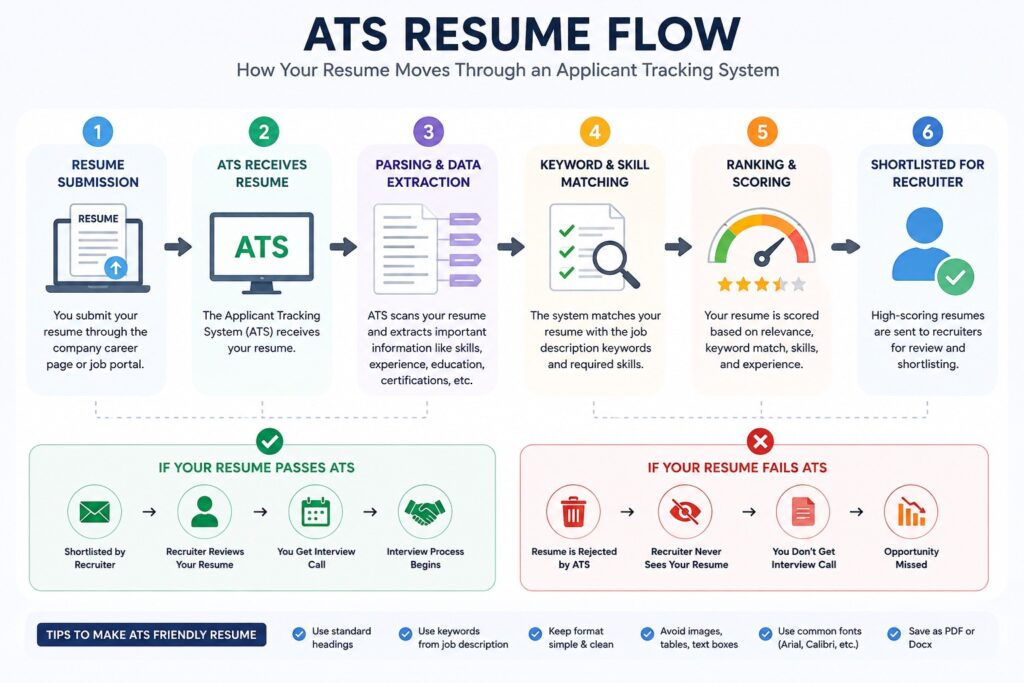
ATS Resume Checklist
✔ Use a clean, professional layout
✔ Stick to standard headings like “Skills,” “Projects,” and “Experience”
✔ Include keywords from the job description naturally
✔ Save your resume as a PDF (unless another format is requested)
✔ Avoid excessive graphics, icons, tables, or text boxes that ATS software may struggle to read
Common Resume Mistakes
- Sending the same resume to every company
- Adding every certification you’ve ever completed without relevance
- Listing tools you can’t confidently explain
- Writing vague responsibilities instead of measurable achievements
- Including outdated or irrelevant information
Remember, your resume should answer one important question:
“Why should this candidate be interviewed?”
Step 2: Customize Your Resume for Every Cyber Security Job
One of the biggest reasons candidates fail to receive interview calls is because they use the same resume for every job application.
Cybersecurity is a broad field with multiple career paths. The skills required for a SOC Analyst differ from those needed for a Penetration Tester, Cloud Security Engineer, or GRC Analyst. Recruiters expect your resume to reflect the specific role you’re applying for.
Instead of sending one generic resume to every company, tailor it according to the job description.
Here’s how you can do it:
- Read the job description carefully.
- Highlight the technical skills the employer is looking for.
- Rearrange your skills section so the most relevant ones appear first.
- Mention projects that match the role.
- Use the same terminology and keywords used in the job posting whenever applicable.
For example, if you’re applying for a SOC Analyst role, emphasize SIEM tools, incident response, log analysis, and threat detection. If it’s a Penetration Tester role, highlight vulnerability assessments, web application testing, Burp Suite, Metasploit, and OWASP Top 10.
A customized resume immediately tells recruiters that you’ve taken the time to understand their requirements and that alone can improve your chances of getting shortlisted.
Step 3: Showcase Practical Experience Instead of Just Certifications
Certifications can help your resume stand out, but they don’t prove that you can perform real-world cybersecurity tasks.
Employers are increasingly looking for candidates who have applied their knowledge through practical experience.
If you’re a fresher, don’t worry. Practical experience doesn’t always mean corporate work experience. You can build your portfolio through:
- Home Labs
- Capture The Flag (CTF) Competitions
- TryHackMe Learning Paths
- Hack The Box Challenges
- Vulnerability Assessment Practice
- Web Application Security Testing
- Active Directory Labs
- Security Monitoring with SIEM Tools
- GitHub Projects
- Internship Assignments
Instead of Writing This:
Wireshark
Write This:
Performed packet capture and network traffic analysis using Wireshark to identify suspicious communication during simulated attack scenarios.
Instead of:
Nmap
Write:
Conducted network reconnaissance using Nmap to identify open ports, running services, and potential security risks across lab environments.
The difference is simple:
Anyone can list a tool. Few candidates can explain how they used it.
That explanation creates confidence in recruiters.
Step 4: Highlight Achievements, Not Responsibilities
Many resumes contain statements like:
- Responsible for vulnerability scanning
- Worked on Linux
- Assisted in penetration testing
- Learned networking
These statements don’t tell recruiters anything about your impact.
Instead, focus on measurable achievements.
Weak Resume Statement
Responsible for vulnerability scanning.
Strong Resume Statement
Performed vulnerability assessments using Nessus and identified over 30 security vulnerabilities across multiple virtual machines while recommending remediation strategies.
Weak Resume Statement
Worked on SIEM.
Strong Resume Statement
Monitored security events using Splunk, analyzed suspicious logs, and investigated simulated security incidents in a lab environment.
Weak Resume Statement
Completed internship.
Strong Resume Statement
Completed a cybersecurity internship involving vulnerability assessments, OSINT research, web application testing, and security documentation under industry mentors.
Numbers, tools, and outcomes make your experience more credible.
Step 5: Build a Technical Portfolio That Recruiters Can Verify
Imagine two candidates applying for the same cybersecurity role.
Both have similar certifications.
One candidate only submits a resume.
The other submits:
- Resume
- GitHub Profile
- LinkedIn Profile
- Home Lab Documentation
- Write-ups
- CTF Solutions
- Personal Portfolio Website
Who do you think the recruiter is more likely to trust?
Your portfolio acts as proof of your skills.
Even if you don’t have professional experience, your portfolio demonstrates curiosity, consistency, and practical knowledge.
Include:
- GitHub repositories
- Home lab screenshots
- Security reports
- Python automation scripts
- Bash scripts
- PowerShell projects
- Web application testing reports
- SIEM dashboards
- Threat hunting notes
- CTF write-ups
A portfolio can significantly increase your credibility during interviews.
Step 6: Optimize Your LinkedIn Profile
Today, your LinkedIn profile is often your second resume.
Many recruiters search LinkedIn before contacting candidates. A well-optimized profile can attract interview opportunities even if you haven’t applied.
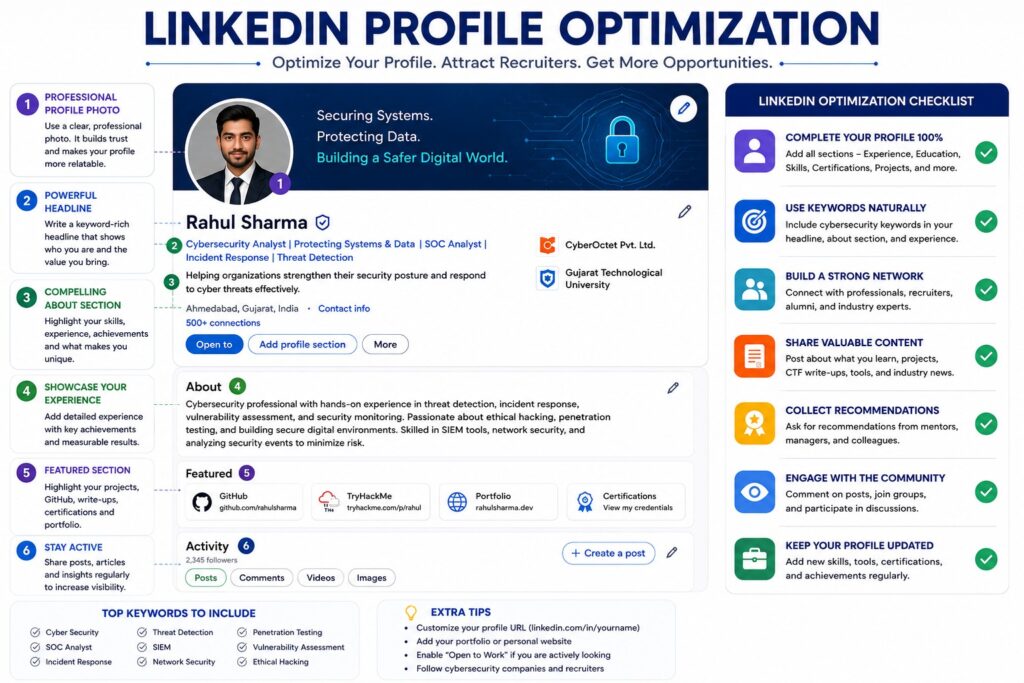
Your LinkedIn Profile Should Include:
✔ Professional profile photo
✔ Strong headline
Example:
Cyber Security Enthusiast | SOC Analyst Aspirant | Ethical Hacking | Network Security | TryHackMe | Security Research
✔ Professional About section
✔ Skills
✔ Certifications
✔ Internship Experience
✔ Practical Projects
✔ GitHub Link
✔ Portfolio Website
✔ Recommendations
✔ Consistent Cybersecurity Posts
Sharing your learning journey, projects, certifications, or industry insights shows recruiters that you’re actively engaged in the cybersecurity community.
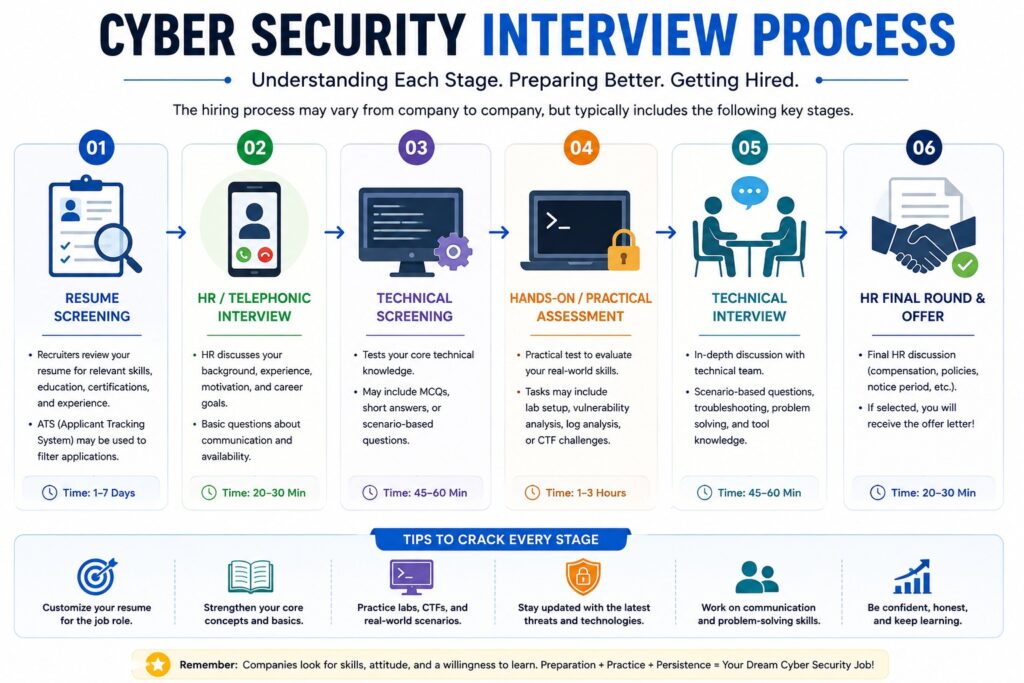
Step 7: Prepare for Technical Interviews Like a Cyber Security Professional
Getting an interview call is a great achievement—but it’s only half the journey. Many candidates get shortlisted but fail to convert interviews into job offers because they focus only on theory instead of demonstrating practical knowledge.
Cybersecurity interviews are designed to assess how you think, not just what you know.
Interviewers want to understand:
- Can you solve security problems?
- Do you understand networking fundamentals?
- Can you explain technical concepts clearly?
- Have you worked on practical labs or projects?
- Can you respond confidently to real-world scenarios?
The best way to prepare is to strengthen your fundamentals and practice explaining concepts in simple language.
Technical Topics You Should Master
Networking Fundamentals
A strong understanding of networking is essential because almost every cyber attack involves network communication.
Prepare topics such as:
- OSI Model
- TCP/IP
- DNS
- DHCP
- HTTP vs. HTTPS
- VPN
- Firewalls
- Ports and Protocols
Operating Systems
Most cybersecurity roles require familiarity with both Windows and Linux.
Focus on:
- Linux Commands
- File Permissions
- Process Management
- User Management
- Windows Registry
- Active Directory Basics
- Windows Event Logs
Web Application Security
If you’re applying for VAPT or Penetration Testing roles, prepare:
- OWASP Top 10
- SQL Injection
- Cross-Site Scripting (XSS)
- Cross-Site Request Forgery (CSRF)
- Authentication & Session Management
- Secure Coding Principles
Security Operations (SOC)
For SOC Analyst roles, understand:
- SIEM
- Log Analysis
- Threat Hunting
- IOC (Indicators of Compromise)
- Incident Response
- Malware Basics
- MITRE ATT&CK Framework
Cloud Security
Cloud security knowledge is becoming increasingly valuable.
Prepare:
- AWS Security Basics
- IAM
- Security Groups
- Azure Security Concepts
- Shared Responsibility Model
Pro Tip
Don’t just memorize definitions.
Instead, explain each concept as if you’re teaching it to someone new. Interviewers appreciate candidates who can communicate technical ideas clearly.
Step 8: Common Cyber Security Interview Questions
While every company has its own hiring process, some questions are commonly asked across cybersecurity interviews.
Here are a few examples:
General Questions
- Tell me about yourself.
- Why did you choose cybersecurity as a career?
- What motivates you to work in information security?
- Explain your final-year project or recent cybersecurity project.
Networking Questions
- What happens when you type a website URL into your browser?
- What is the difference between TCP and UDP?
- Explain DNS.
- What is ARP?
- What are common network ports?
Linux Questions
- How do you check running processes?
- Explain file permissions.
- Difference between root and sudo.
- What are symbolic links?
Web Security Questions
- Explain SQL Injection.
- What is XSS?
- What is CSRF?
- What is Authentication vs. Authorization?
SOC Questions
- What is SIEM?
- How would you investigate a phishing email?
- Explain the Incident Response lifecycle.
- What would you do if a user reports ransomware?
Practical Questions
Interviewers may also ask:
- Describe your Home Lab.
- Which projects are you most proud of?
- Which cybersecurity tools have you used?
- What challenges did you face during your internship?
- Can you demonstrate how you performed vulnerability scanning?
These questions help employers understand whether you’ve applied your knowledge in real-world scenarios.
Step 9: Develop the Soft Skills Employers Value
Technical expertise is important, but cybersecurity professionals also work with clients, management teams, developers, auditors, and business stakeholders.
That’s why employers look for candidates with strong communication and collaboration skills.
The most valued soft skills include:
- Communication
- Critical Thinking
- Problem Solving
- Analytical Skills
- Time Management
- Teamwork
- Documentation Skills
- Professional Ethics
- Continuous Learning Mindset
Imagine discovering critical security vulnerability.
Finding the issue is only part of the job.
You also need to explain:
- What the vulnerability is.
- How it impacts the business.
- How it can be fixed.
- Why it should be prioritized.
Your ability to communicate technical findings effectively can set you apart from other candidates.
Step 10: Common Mistakes That Reduce Your Chances of Getting Hired
Even skilled candidates miss interview opportunities because of avoidable mistakes.
Here are some of the most common ones:
✖ Sending the Same Resume Everywhere
Customize your resume based on the role you’re applying for.
✖ Listing Skills You Can’t Explain
Never mention tools or technologies unless you’re comfortable discussing them during the interview.
✖ Ignoring Practical Experience
Recruiters value projects, labs, internships, and CTF participation more than long lists of certifications.
✖ Weak LinkedIn Profile
An incomplete or outdated LinkedIn profile can reduce your credibility.
✖ No Portfolio
Without GitHub projects, lab documentation, or a portfolio website, recruiters have no way to verify your practical skills.
✖ Poor Communication
Being technically strong isn’t enough if you struggle to explain your thought process.
✖ Stopping Learning
Cybersecurity evolves rapidly. Employers prefer candidates who continuously upgrade their knowledge and stay informed about emerging threats.
Quick Checklist before Applying for a Cyber Security Job
| Checklist | Status |
| ATS-Friendly Resume | ✔ |
| Customized Resume | ✔ |
| LinkedIn Updated | ✔ |
| GitHub Portfolio | ✔ |
| Practical Projects | ✔ |
| Internship Experience | ✔ |
| Mock Interviews Completed | ✔ |
| Technical Concepts Revised | ✔ |
| Soft Skills Improved | ✔ |
Breaking into cybersecurity requires more than completing a course or collecting certifications. Employers want professionals who can demonstrate practical expertise, solve real-world problems, communicate effectively, and adapt to an ever-changing threat landscape.
Every step in your hiring journey matters from crafting an ATS-friendly resume and building a strong portfolio to preparing for interviews and showcasing your practical experience. Small improvements at each stage can significantly increase your chances of standing out in a competitive job market.
Remember, your resume may get you an interview, but your skills, confidence, and preparation are what ultimately help you secure the job.
If you stay consistent, continue learning, and keep improving your practical abilities, you’ll be well on your way to building a successful career in cybersecurity.
Start Your Cyber Security Career with Cyber Octet
At Cyber Octet, we believe that cybersecurity education should go beyond theory. Our industry-focused training programs are designed to help students develop practical skills that employers value.
Our programs include:
- Hands-on Practical Training
- Live Projects & Real-World Scenarios
- Resume Building & ATS Optimization
- LinkedIn Profile Enhancement
- Mock Technical & HR Interviews
- Internship Opportunities
- Industry Mentorship
- 100% Placement Assistance
Whether you’re starting your cybersecurity journey or looking to advance your career, Cyber Octet provides the guidance, practical exposure, and career support you need to move confidently from learning to getting hired.
Ready to start your Cyber Security career?
Join CyberOctet’s industry-oriented Cyber Security Training Program with Live Projects, Internship, Resume Building, Mock Interviews and 100% Placement Assistance.
📞 Contact Us Today
Frequently Asked Questions (FAQs)
1. Can I get a cybersecurity job without experience?
Yes. Practical projects, home labs, internships, CTF challenges, and GitHub repositories can demonstrate your skills even if you don’t have professional work experience.
2. What should a cybersecurity fresher include in a resume?
Your resume should highlight technical skills, certifications, practical projects, internships, tools you’ve worked with, GitHub profile, LinkedIn profile, and measurable achievements.
3. Is LinkedIn important for cybersecurity jobs?
Absolutely. Many recruiters search for candidates on LinkedIn before scheduling interviews. A professional profile showcasing your skills, certifications, and projects can improve your visibility.
4. Which technical skills are most important for beginners?
Strong fundamentals in networking, Linux, Windows, web application security, scripting, SIEM basics, and cloud security are highly valuable for entry-level cybersecurity roles.
5. How can I stand out from other cybersecurity candidates?
Build practical projects, maintain an active GitHub portfolio, optimize your LinkedIn profile, participate in CTF competitions, and prepare thoroughly for technical interviews.

)