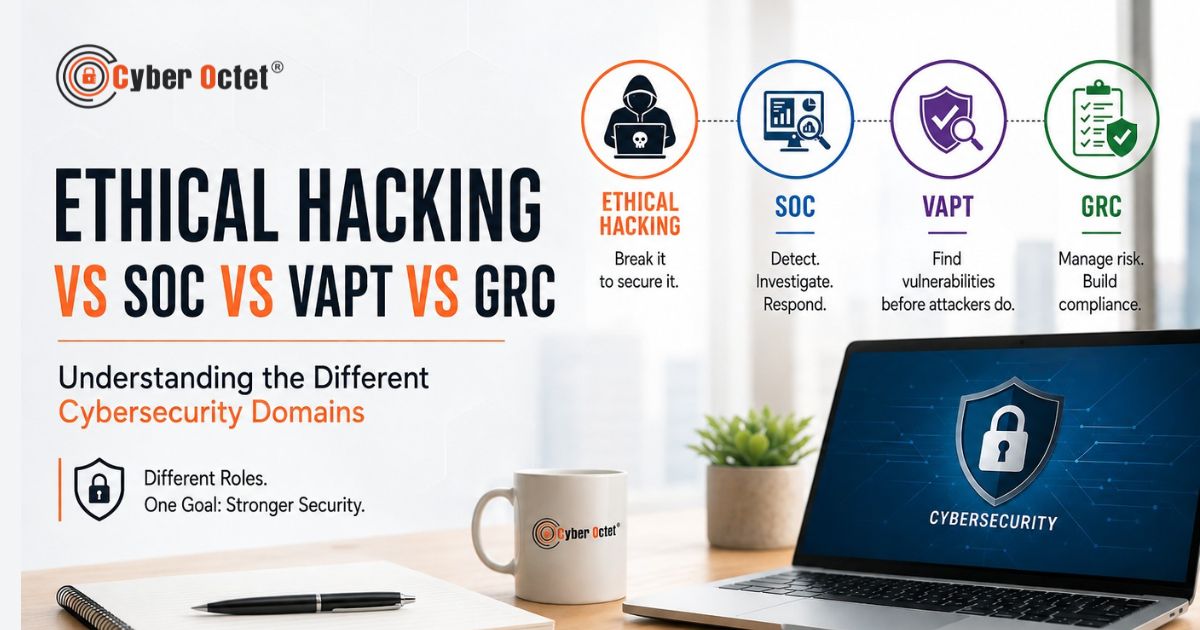
Cybersecurity is a broad field made up of many specialized areas. Four terms that are commonly discussed together are Ethical Hacking, SOC, VAPT, and GRC.
While all four are related to cybersecurity, they do not perform the same function.
Ethical Hacking focuses on identifying security weaknesses from an attacker’s perspective. SOC teams focus on detecting and responding to security threats. VAPT focuses on identifying and validating vulnerabilities, while GRC focuses on governance, risk management, and compliance.
Understanding these differences is useful for anyone interested in cybersecurity, whether you are a student, technology professional, business owner, or simply looking to improve your cybersecurity awareness.
What Is Ethical Hacking?
Ethical hacking is the authorized practice of testing computer systems, networks, applications, or other digital assets to identify security weaknesses.
An ethical hacker uses techniques that may be similar to those used by malicious attackers, but the key difference is authorization and purpose.
The goal is to identify weaknesses before they can be exploited by criminals.
Ethical hackers may assess areas such as:
- Networks
- Web applications
- Mobile applications
- APIs
- Wireless networks
- Authentication mechanisms
- Access controls
- System configurations
Ethical hacking is generally associated with offensive security because it approaches cybersecurity from the perspective of how an attacker might attempt to compromise a system.
A simple way to understand ethical hacking is:
Break it to secure it.
What Does an Ethical Hacker Do?
An ethical hacker may:
- Understand the scope and objectives of an authorized security assessment.
- Identify possible attack surfaces.
- Test systems for security weaknesses.
- Validate whether weaknesses can be exploited.
- Document findings and potential impact.
- Provide recommendations to improve security.
Ethical hacking must always be performed within an agreed scope and with proper authorization.
What Is a SOC in Cybersecurity?
SOC stands for Security Operations Center.
A Security Operations Center is responsible for monitoring an organization’s technology environment and identifying potential cybersecurity incidents.
While ethical hacking is generally proactive testing, SOC operations are primarily focused on continuous monitoring, detection, investigation, and response.
A SOC may monitor:
- Network activity
- Endpoint activity
- Authentication events
- Security alerts
- Suspicious user behavior
- Malware indicators
- System logs
- Cloud environments
- Security events
SOC teams often use technologies such as SIEM platforms, endpoint detection tools, threat intelligence, and other security monitoring solutions.
What Does a SOC Analyst Do?
A SOC analyst may:
- Monitor security alerts
- Investigate suspicious activity
- Analyze logs and security events
- Identify potential indicators of compromise
- Determine the severity of incidents
- Escalate serious incidents
- Support incident response activities
- Document security events
A simplified SOC workflow can be understood as:
Detect → Investigate → Respond → Recover
The objective is to identify potentially malicious activity as early as possible and support an appropriate response.
What Is VAPT?
VAPT stands for Vulnerability Assessment and Penetration Testing.
VAPT is a structured approach used to identify security vulnerabilities and evaluate their potential impact.
Although Vulnerability Assessment and Penetration Testing are often mentioned together, they are not exactly the same.
What Is Vulnerability Assessment?
Vulnerability assessment focuses on identifying and evaluating known security weaknesses.
It can involve automated scanning, configuration reviews, manual analysis, and other assessment techniques.
A vulnerability assessment helps answer questions such as:
- What vulnerabilities exist?
- Where are they located?
- How serious are they?
- Which vulnerabilities should be prioritized?
What Is Penetration Testing?
Penetration testing involves authorized attempts to exploit security weaknesses in a controlled environment.
The purpose is to determine whether a vulnerability can actually be exploited and understand the potential security impact.
For example, a vulnerability scanner may identify a potentially vulnerable component. A penetration tester may then investigate whether the vulnerability can be practically exploited under the agreed scope.
Penetration testing can involve areas such as:
- Web applications
- Networks
- APIs
- Mobile applications
- Cloud environments
- Wireless networks
The important point is that penetration testing must be authorized and performed within a defined scope.
What Is GRC in Cybersecurity?
GRC stands for Governance, Risk, and Compliance.
GRC takes a different approach from technical security testing.
Instead of primarily focusing on finding vulnerabilities or monitoring security events, GRC focuses on how an organization manages cybersecurity risks, policies, controls, governance, and compliance requirements.
Governance
Governance defines how cybersecurity and information security are managed within an organization.
It can include:
- Security policies
- Roles and responsibilities
- Procedures
- Security objectives
- Management oversight
- Security frameworks
Risk Management
Risk management involves identifying and evaluating risks that could affect an organization’s systems, information, operations, or business objectives.
Organizations may consider factors such as:
- Likelihood of an event
- Potential impact
- Existing security controls
- Business importance
- Risk treatment options
The objective is to understand and manage security risks in a structured way.
Compliance
Compliance focuses on meeting applicable laws, regulations, standards, contractual obligations, and internal requirements.
Depending on the organization and industry, this may involve information security standards, privacy requirements, regulatory frameworks, or contractual security requirements.
GRC therefore provides a structured approach for managing cybersecurity from an organizational and risk perspective.
Ethical Hacking vs SOC vs VAPT vs GRC
The simplest way to understand the difference is to look at the primary question each area tries to answer.
| Cybersecurity Domain | Main Focus | Key Question |
| Ethical Hacking | Offensive security testing | How could an attacker compromise this system? |
| SOC | Threat detection and response | Is suspicious activity happening? |
| VAPT | Vulnerability identification and validation | What weaknesses exist and can they be exploited? |
| GRC | Governance, risk and compliance | How should security risks and requirements be managed? |
Each domain approaches cybersecurity from a different perspective.
What Is the Difference Between Ethical Hacking and VAPT?
Ethical hacking and VAPT have significant overlap, but they are not always interchangeable terms.
Ethical hacking is a broader concept involving authorized offensive security activities.
VAPT specifically refers to vulnerability assessment and penetration testing.
For example, a security professional may perform vulnerability scanning to identify weaknesses and then conduct penetration testing to validate selected findings.
Ethical hacking can include penetration testing, but the term may also be used more broadly for authorized offensive security activities.
What Is the Difference Between SOC and VAPT?
SOC and VAPT have different primary objectives.
VAPT is generally conducted to identify and validate security weaknesses in systems and applications.
SOC operations focus on continuously monitoring environments and responding to potential threats.
In simple terms:
VAPT asks:
“What security weaknesses exist?”
SOC asks:
“Is there suspicious or malicious activity happening?”
Both functions can contribute to an organization’s overall security posture.
What Is the Difference Between Ethical Hacking and SOC?
Ethical hacking generally takes an offensive perspective, while SOC operations generally take a defensive and monitoring perspective.
An ethical hacker may simulate attack techniques to discover weaknesses.
A SOC analyst may investigate security alerts and suspicious activity to identify potential attacks.
One focuses on testing how systems could be compromised, while the other focuses on detecting and responding when suspicious activity occurs.
What Is the Difference Between GRC and Technical Cybersecurity?
GRC focuses primarily on governance, risk, policies, controls, and compliance.
Technical cybersecurity areas such as ethical hacking, VAPT, and SOC operations often involve hands-on technical testing, monitoring, investigation, or response.
However, GRC and technical cybersecurity are closely connected.
For example, findings from a penetration test may contribute to an organization’s risk assessment. Similarly, security incidents identified by a SOC may result in changes to policies, controls, or risk management processes.
How Do Ethical Hacking, SOC, VAPT, and GRC Work Together?
These four areas should not be viewed as completely separate functions.
They can work together as part of a broader cybersecurity program.
For example:
- VAPT identifies security weaknesses.
- Ethical hacking or penetration testing can help validate specific weaknesses.
- SOC teams monitor the environment for suspicious activity.
- GRC teams help manage risks, controls, policies, and compliance requirements.
- Findings from these activities can be used to improve the organization’s overall security posture.
This creates a continuous security improvement cycle:
Identify → Assess → Protect → Monitor → Respond → Improve
A strong cybersecurity strategy generally requires multiple perspectives rather than relying on a single security function.
What Skills Are Relevant to These Cybersecurity Domains?
The skills required can vary depending on the role and organization.
Ethical Hacking Skills
Common areas of knowledge may include:
- Networking fundamentals
- Operating systems
- Web application security
- Security testing methodologies
- Vulnerability analysis
- Authentication and access control
- Security tools
- Scripting and automation
SOC Skills
SOC-related skills may include:
- Networking
- Log analysis
- Security monitoring
- Incident investigation
- SIEM platforms
- Threat intelligence
- Endpoint security
- Incident response
- Basic digital forensics
VAPT Skills
VAPT-related knowledge may include:
- Network security
- Web application security
- Vulnerability assessment
- Penetration testing methodologies
- Security testing tools
- Manual testing
- Risk assessment
- Technical reporting
GRC Skills
GRC-related skills may include:
- Risk assessment
- Security policies
- Governance
- Compliance
- Security controls
- Auditing
- Documentation
- Security frameworks
- Communication and reporting
These are broad skill areas, and the exact requirements vary depending on the role and organization.
Which Cybersecurity Domain Should You Choose?
There is no single cybersecurity domain that is best for everyone.
Your interests and strengths can help determine which area you may want to explore.
If you enjoy understanding how systems can be attacked and finding technical weaknesses, ethical hacking or VAPT may be interesting areas to explore.
If you enjoy monitoring systems, investigating alerts, and responding to suspicious activity, SOC operations may be a better fit.
If you are interested in risk management, policies, auditing, security controls, and compliance requirements, GRC may be worth exploring.
It is also possible to move between cybersecurity domains as your knowledge and experience develop.
Common Misconceptions About These Cybersecurity Domains
Is ethical hacking the same as illegal hacking?
No.
Ethical hacking is authorized security testing. Performing security testing without permission can be unlawful and can cause harm.
Does a SOC only monitor alerts?
No.
SOC teams may investigate alerts, analyze security events, identify potential incidents, escalate cases, and support response activities.
Does VAPT only mean vulnerability scanning?
No.
VAPT includes vulnerability assessment and penetration testing. Penetration testing can involve controlled manual attempts to validate whether identified weaknesses are practically exploitable.
Is GRC unrelated to cybersecurity?
No.
GRC is an important part of cybersecurity management because organizations need processes for managing risks, security controls, governance, and applicable requirements.
Can automated tools find every vulnerability?
No security tool should be treated as a complete replacement for human analysis.
Automated tools can efficiently identify many known issues, but manual analysis can be important for understanding context, business logic, attack paths, authorization issues, and other complex weaknesses.
Frequently Asked Questions
What is the difference between Ethical Hacking, SOC, VAPT, and GRC?
Ethical Hacking focuses on authorized offensive security testing. SOC focuses on detecting and responding to security threats. VAPT focuses on identifying and validating vulnerabilities. GRC focuses on governance, risk management, and compliance.
Which is better, Ethical Hacking or VAPT?
Neither is universally better. They have overlapping areas but different scopes. Ethical hacking is a broader term for authorized offensive security activities, while VAPT specifically focuses on vulnerability assessment and penetration testing.
Is SOC a defensive cybersecurity role?
Generally, yes. SOC operations are primarily associated with defensive security, including monitoring, threat detection, investigation, and incident response.
What does GRC stand for in cybersecurity?
GRC stands for Governance, Risk, and Compliance. It focuses on managing security governance, organizational risks, security controls, and applicable compliance requirements.
Can someone work in more than one cybersecurity domain?
Yes. Cybersecurity professionals can develop skills across multiple domains. Experience in one area can also provide useful knowledge for working in another.
Is VAPT the same as penetration testing?
Not exactly. VAPT stands for Vulnerability Assessment and Penetration Testing. Vulnerability assessment focuses on identifying and evaluating vulnerabilities, while penetration testing involves controlled attempts to exploit weaknesses.
Which cybersecurity domain is best for beginners?
There is no universal answer. Beginners can explore cybersecurity fundamentals first and then learn more about different domains to determine which type of work matches their interests and strengths.
Final Thoughts
Ethical Hacking, SOC, VAPT, and GRC are four important areas within the broader cybersecurity ecosystem.
Ethical Hacking focuses on understanding security from an attacker’s perspective. VAPT focuses on finding and validating vulnerabilities. SOC teams focus on monitoring, detecting, investigating, and responding to threats. GRC focuses on governance, risk management, and compliance.
Understanding these differences can make the cybersecurity landscape easier to navigate and can help individuals and organizations recognize how different security functions contribute to a stronger security posture.
Cybersecurity is not a single discipline. It is a combination of technical skills, monitoring, testing, risk management, governance, and continuous improvement.
Want to Explore Cybersecurity Further?
If you want to learn more about different cybersecurity domains, explore the resources and cybersecurity learning programs available through Cyber Octet.
You can explore the Cyber Octet cybersecurity courses and learn more about the different areas covered through the official website.
Cybersecurity awareness starts with understanding how security works and continuous learning helps build stronger digital security.