Introduction
How Falgun Rathod’s Book is Supporting Cyber Security Education – Why Institutional Recognition Is More Important Than Ever
The Future of Cyber Security Starts With Education
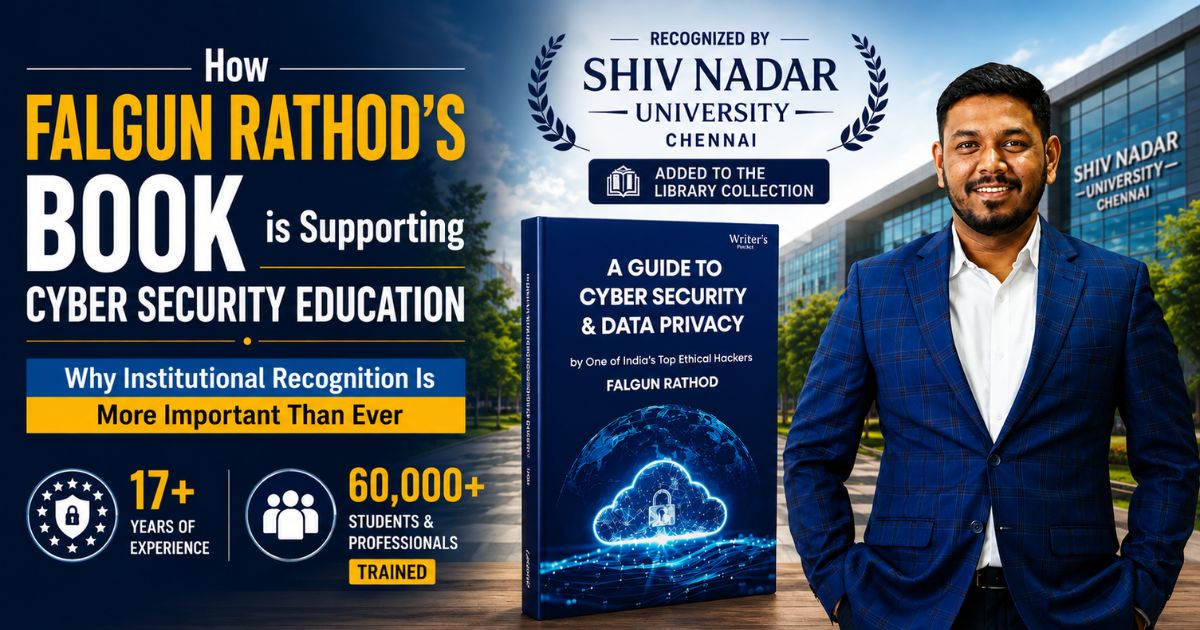
The recent inclusion of A Guide to Cyber Security & Data Privacy by Falgun Rathod in the library collection of Shiv Nadar University Chennai highlights the growing importance of practical cyber security education. As universities increasingly recognize the value of accessible and industry-relevant learning resources, this milestone reflects a broader shift toward building cyber-aware students and future-ready professionals.
Ten years ago, cyber security was generally considered a niche discipline for IT professionals, ethical hackers and information security teams. Now the impression of it has altered tremendously.
Every person who uses a smartphone, accesses online banking, works remotely, shops online, or shares personal information on the Internet has become part of the global digital ecosystem. With the advances in technology, cyber security is no longer only about safeguarding systems, it is about protecting individuals, businesses and society.
Ransomware attacks targeting hospitals, phishing campaigns affecting colleges and international corporations – cyber threats have gotten more complex, common and financially destructive. While corporations are investing in new security solutions, one thing remains true: technology alone cannot do away with cyber dangers.
An aware and knowledgeable society is the best defense against cyber threats.
That is why cyber security education is one of the most critical investments organizations can make, not just for today’s professionals, but for the next generation of digital citizens.
Cyber Security is Not Just a Technical Subject
For a long time, cyber security education was mostly represented by technical certifications, engineering programs and professional training courses. The digital landscape today, however, is a different.
A student working on online homework in college
A health care professional accessing patient records.
a financial exec involved in sensitive deals
A government worker having access to classified information…
A parent guiding a child through the digital world…
Every single one of them confronts threats every day from cyber.
The digital world has revolutionized the way we learn, interact, do business and save information. With these prospects comes an ever greater duty to grasp cyber dangers, data protection, digital ethics and responsible online behaviour.
Cyber security is not just a career option, it is now a life skill.”
This global trend has forced educational institutions, corporations and governments to re-evaluate how they should teach cyber security expertise. The awareness is no longer confined to technological groups; institutions are opening up cyber security education in different areas.
Knowledge is never confined to a classroom. It should be open to all who choose to learn.
Why Universities Are Investing in Cyber Security Resources
Universities have always been about more than just academic study. These are the venues where ideas are born, research is performed, innovation is forged and future leaders are created.
The students of today will be the entrepreneurs, engineers, health care professionals, policy officials, educators and business executives of tomorrow. The level of their cybersecurity knowledge will have a direct impact on how securely enterprises and societies will operate in the future.
Universities across the globe are recognizing this obligation and are expanding access to cyber security learning resources through libraries, research centers, workshops, digital repositories, and interdisciplinary programs.
Libraries still have an important role to play in this shift.
Unlike the constantly changing online material, academic libraries offer vetted, credible and trusted resources for learners. They enable deeper learning, critical thinking and evidence-based comprehension of complex issues.
When a cyber security book enters the collection of a university library, it is more than just another publication on a shelf.
It shows an organization’s dedication to providing cyber security knowledge to its academic community.
This momentum is part of a wider shift towards constructing technologically responsible societies that reward awareness as much as technical competence.
Knowledge creates Cyber Resilience
When a business talks about cyber resilience, the conversation typically centers on firewalls, artificial intelligence, threat detection systems, endpoint protection and zero-trust architectures.
These technologies are crucial.
But even the most sophisticated security infrastructure can be breached if people are not aware of the most frequent cyber risks.
Most cyber issues aren’t initiated by sophisticated hacking.
They start with simple human errors.
A phishing email.
Weak password
A non-secure, open wi-fi connection.
An inadvertent click on a malware attachment.
Not knowing how to protect your personal information.
Technology alone does not build cyber resilience.
It is built by informed choices.
All employees who detect a phishing attempt…
Every student who understands the necessity of good passwords…
All data privacy respecting professional…
Any group that spends money on training for awareness…
helps build a safer, stronger digital ecosystem.
Education turns people from potential targets into the first line of defense.
That is why awareness programmes, books, workshops, research papers and institutional learning materials are still important in boosting global cyber security.
Knowledge is more than information.
In cyber security, knowledge is your defense.
And resilience is built through protection.
The World Is Moving Toward Cyber Literacy
More and more governments, institutions, businesses and international organizations are realizing that cyber security awareness is not a one-time initiative but a continual practice.
Digital transformation is driven by new technologies such as Artificial Intelligence, cloud computing, IoT, blockchain, and quantum computing, therefore the need for cyber-literate professionals and digitally knowledgeable individuals will continue to grow.
The future of the workplace will need experts who understand not only their own industry but the cyber threats linked with it.
Similarly, schools will continue to be key in preparing learners for a future in which understanding of cyber security is as important as digital literacy itself.
This progress is more than a technological shift.
It marks a cultural transformation, where cyber security education is a fundamental aspect of lifelong learning, not a specialist subject for a chosen few.
In this regard, educational resources, expert insights and practical learning materials are progressively becoming relevant in academic and institutional environments globally.
From Knowledge Sharing to Academic Recognition
Every author reaches a point when the work they have made starts to connect with the audience it was initially intended for. For educators and cyber security professionals, that moment becomes even more important when knowledge is found within an academic institution.
One such milestone was the recognition of *A Guide to Cyber Security & Data Privacy* by **Shiv Nadar University, Chennai**.
This is not an individual achievement but something far bigger, the growing importance of cyber security education in higher learning institutions.
As colleges equip students for a technology-powered future, practical and credible cyber security tools are becoming more crucial.
Academic libraries have been centers of study, research and innovation. Universities are helping students gain knowledge far beyond the classroom by introducing resources that focus on cyber security, digital privacy and responsible technology use.
This is a sign of the rising realization that cyber security is no longer an elective. It is becoming an integral aspect of modern schooling.
How Falgun Rathod Wrote a Practical Cyber Security Book
All books start with an idea.
In this situation, the concept was simple.
How can you convey cybersecurity ideas in a practical, intelligible and relevant way to students, professionals, educators and those from non-technical backgrounds?
**Falgun Rathod** has worked with thousands of students, corporates, educational institutions and organizations in his career.
One problem kept coming up again and again.
There was a lot of interest in learning about cyber security but sometimes people considered it too technical or daunting.
Technical vocabulary, sophisticated attack techniques, and constantly changing technology often posed barriers for beginners who merely wanted to understand how to protect themselves and their companies.
This observation culminated in the creation of *A Guide to Cyber Security & Data Privacy*.
The book is created from a practical point of view and not just advanced technical notions. It helps readers comprehend cyber risks, online safety, data privacy, responsible digital behaviours and the need of cyber awareness in everyday life.
It’s never been the goal to replace technical certificates.
The purpose was to increase awareness.
Because awareness is where all secure digital journeys begin.
The Importance of This Recognition
When a university adds a book to the university library collection, it is part of an ecosystem that supports learning, research and knowledge sharing.
Students are exposed to alternative views.
Researchers have identified a useful reference material.
Educators are provided with resources to support classroom discussions.
Most significantly, learners are encouraged to cultivate the habit of exploring cyber security beyond exams and certifications.
At **Shiv Nadar University Chennai**, the library collection of *A Guide to Cyber Security & Data Privacy* is a testament to the growing need for instructional materials that connect theoretical knowledge with real-world understanding.
It is heartening to see schools acknowledging the need to give students access to tools that break down complicated cyber security topics and foster ongoing learning.
Today, knowledge is equally as important as skills in the digital age.
Why Cyber Security Education Matters for Every Student and Professional
A cyber-aware society cannot be built by educational institutions alone.
Industry professionals, educators, researchers, governments, businesses and technological communities all have a critical role to play.
All these books, workshops, awareness campaigns, research publications, practical training and open conversations all add up to a stronger cyber literacy.
Greater availability of cyber security information helps individuals to recognize online security issues, protect private data, and make smarter decisions online.
As cyber threats continue to morph across every sector, this collaborative approach is growing in importance.
Cyber security awareness should not wait for an incident to occur.
It should start well before then, in schooling.
That’s why institutional access to accurate cyber security knowledge is important.
It creates knowledgeable learners who develop into responsible professionals and digitally aware citizens.
Today’s knowledge is tomorrow’s resilience.
Cyber Octet’s Commitment to Building a Cyber-Aware Future
At Cyber Octet, we have always believed that cyber security is about more than technology. It is about people, awareness, and the ability to make informed decisions in an increasingly digital world.
For over 16 years, Cyber Octet has worked with students, working professionals, educational institutions, businesses, and government organizations to strengthen cyber security awareness through practical learning and industry-driven training.
Our mission has remained consistent—to bridge the gap between theoretical knowledge and real-world cyber security challenges.
This commitment extends beyond classrooms and training labs. Through awareness campaigns, workshops, seminars, research initiatives, and educational resources, we continue to encourage a culture where cyber security becomes a shared responsibility rather than the responsibility of a few specialists.
Recognition of educational resources such as A Guide to Cyber Security & Data Privacy reinforces the importance of this mission. It demonstrates that institutions are increasingly looking beyond traditional academic material and embracing practical resources that help learners understand cyber risks, digital responsibility, and data privacy in a rapidly evolving digital landscape.
Education remains one of the most powerful tools for creating resilient individuals, organizations, and communities.
Looking Ahead: The Future of Cyber Security Education
The future of cyber security will not be defined solely by emerging technologies.
Artificial Intelligence, cloud computing, IoT, automation, and quantum computing will continue to reshape the digital landscape. While these technologies create new opportunities, they also introduce new security challenges that require informed decision-making and responsible digital practices.
Tomorrow’s workforce will need more than technical expertise. They will need cyber awareness, critical thinking, digital ethics, and an understanding of how technology influences every aspect of society.
Educational institutions are already adapting to this shift by integrating cyber security into broader learning environments. The inclusion of practical learning resources within university libraries reflects this evolution and supports a new generation of learners who view cyber security as an essential life skill rather than a niche technical subject.
- As awareness grows, so does resilience.
Every student who learns how to recognise a phishing email, protect personal information, or understand the importance of digital privacy contributes to creating a safer digital ecosystem.
The future belongs not only to those who build technology but also to those who know how to use it securely and responsibly.
A Milestone That Represents a Bigger Purpose
The cataloging of A Guide to Cyber Security & Data Privacy in the library collection of Shiv Nadar University Chennai is an encouraging milestone, but its true significance lies beyond the recognition itself.
It reflects the growing importance of making cyber security knowledge accessible to learners, educators, and researchers.
It reinforces the idea that cyber awareness should be integrated into mainstream education.
Most importantly, it demonstrates that meaningful educational resources can contribute to strengthening digital literacy and preparing individuals for the challenges of an increasingly connected world.
Every institution that invests in cyber security education invests in something much greater than technology.
- It invests in informed people.
And informed people build safer organizations, stronger communities, and a more resilient digital future.
About the Author
Falgun Rathod is a Cyber Security Expert, TEDx Speaker, Author, and Founder & Managing Director of Cyber Octet. With over 17 years of experience in cyber security, he has trained more than 60,000 students and professionals through industry-focused training programs, awareness initiatives, workshops, and consulting engagements.
His work is centred on making cyber security education practical, accessible, and relevant for learners, professionals, educational institutions, and organizations worldwide. Through his book, A Guide to Cyber Security & Data Privacy, he continues to contribute to the global conversation on cyber awareness, digital responsibility, and information security.
About Cyber Octet
Cyber Octet is a leading cyber security training and consulting organization committed to building a cyber-aware society through education, innovation, and practical learning.
Our expertise spans cyber security training, ethical hacking, digital forensics, cyber awareness programs, vulnerability assessment, penetration testing, governance, risk and compliance (GRC), and enterprise cyber security solutions.
By combining industry expertise with hands-on learning, Cyber Octet empowers students, professionals, businesses, and institutions to strengthen cyber resilience and confidently navigate today’s digital landscape.
Continue Your Cyber Security Journey
Whether you are looking for a cyber security book, exploring a career in cyber security, or searching for trusted cyber security learning resources, continuous learning is the foundation of digital resilience. A Guide to Cyber Security & Data Privacy by Falgun Rathod is designed to help students, professionals, and institutions build practical cyber security knowledge.Whether you are a student exploring career opportunities, a professional looking to strengthen your understanding of cyber risks, or an organization focused on building digital resilience, continuous learning is the key to staying ahead.
Frequently Asked Questions (FAQs)
1. Why is cyber security education important today?
Cyber security education equips individuals with the knowledge to identify, prevent, and respond to digital threats. As cyberattacks become more sophisticated, understanding cyber security is no longer limited to IT professionals. Students, educators, businesses, and everyday internet users all benefit from developing cyber awareness and responsible digital practices.
2. Why should universities include cyber security resources in their libraries?
University libraries provide students and researchers with credible, research-backed learning resources. Including cyber security books helps learners build practical knowledge, understand emerging cyber threats, and develop digital resilience beyond classroom learning. Institutional access to trusted resources supports lifelong learning and strengthens cyber literacy.
3. What is A Guide to Cyber Security & Data Privacy about?
A Guide to Cyber Security & Data Privacy by Falgun Rathod is a practical resource designed to help students, professionals, and technology enthusiasts understand cyber security fundamentals, data privacy, cyber threats, digital safety, and responsible online behaviour. The book focuses on making complex cyber security concepts easy to understand for readers from both technical and non-technical backgrounds.
4. Why is the inclusion of this book in Shiv Nadar University Chennai significant?
The inclusion of A Guide to Cyber Security & Data Privacy in the library collection of Shiv Nadar University Chennai reflects the growing importance of cyber security education within academic institutions. It demonstrates how universities are expanding access to practical learning resources that prepare students for an increasingly digital and connected world.
5. Who is Falgun Rathod?
Falgun Rathod is a Cyber Security Expert, TEDx Speaker, Author, and Founder & Managing Director of Cyber Octet. With over 17 years of experience, he has trained more than 60,000 students and professionals through cyber security workshops, training programs, seminars, and industry collaborations. His work focuses on advancing cyber security awareness, ethical hacking education, and digital resilience.
6. How does cyber security awareness benefit students and professionals?
Cyber security awareness helps individuals recognise phishing attacks, protect sensitive information, create stronger passwords, safeguard personal and organizational data, and adopt secure online practices. Developing these skills improves digital confidence and prepares students and professionals to navigate today’s technology-driven environment responsibly.
7. What role does Cyber Octet play in cyber security education?
Cyber Octet is committed to strengthening cyber resilience through practical cyber security training, awareness programs, workshops, consulting, and industry-focused learning. By working with educational institutions, businesses, government organizations, and professionals, Cyber Octet helps bridge the gap between academic learning and real-world cyber security challenges.
8. How can I improve my cyber security knowledge?
Continuous learning is the best way to stay updated in the rapidly evolving cyber security landscape. Reading trusted books, participating in cyber security workshops, following industry experts, enrolling in professional training programs, and staying informed about emerging cyber threats all contribute to building strong cyber security awareness and digital resilience.